
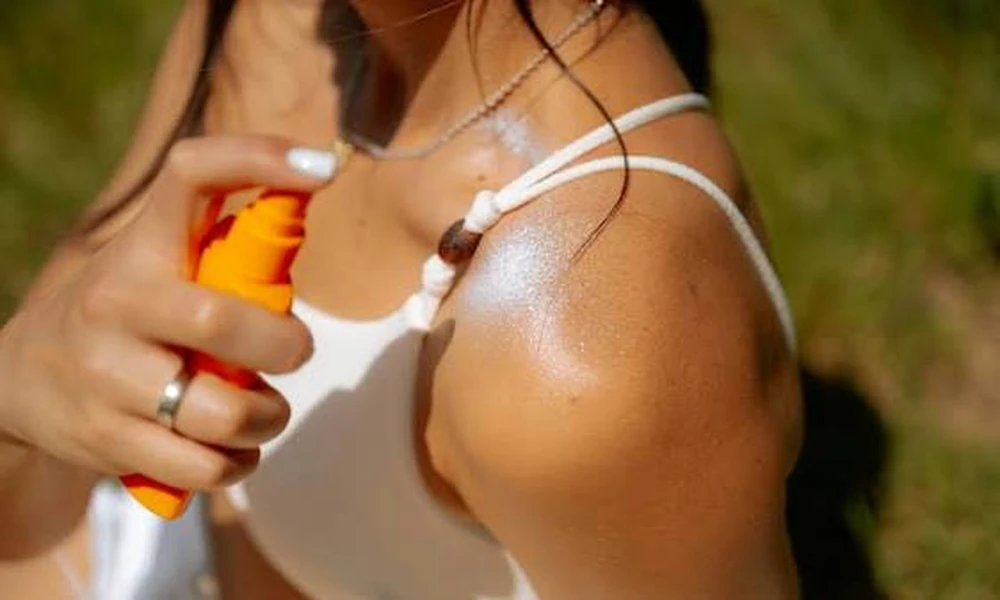
Read the words beside a sunscreen’s numbers before comparing bottles. An SPF value and a water-resistance claim expressed in minutes describe different information. Neither gives you a personal allowance to stay outdoors after a facial. Keep the product’s directions together with any instructions for the actual treatment, rather than choosing whichever prominent number looks largest.
This is an easy mistake to make while repacking a beauty bag. One bottle displays an SPF prominently; another gives considerable space to its water-resistance claim. A photograph crops out the small print, and the saved image becomes a shorthand shopping reference. By the time you leave for an appointment, you remember a number but not what it measured.
Find the unit beside the prominent number
Start with the complete front label, then turn the bottle around. Find SPF, any broad-spectrum wording, the water-resistance description and the directions. Do not combine the figures into a new rating. If a retailer’s image is too small to read, use the actual packaging or obtain a clear current label before relying on the image.
Health Canada’s sunscreen guidance recommends broad-spectrum SPF 30 or higher and following the label. It also explains that SPF is affected in practice by factors including how much is applied and how often. The number is not an instruction to multiply the time you would otherwise spend in sunlight.
SPF expresses relative protection against sunburn under the conditions used to assess it. Health Canada describes it by comparing how long protected and unprotected skin would take to burn when the recommended amount is used. That comparison is useful for understanding the rating; it is not a calculation that can predict your own afternoon from a remembered time to burning.
Broad-spectrum wording answers a separate question about the range of ultraviolet protection. Health Canada explains that it covers UVA and UVB; UVB is the main cause of sunburn. A shopper seeking that wider coverage needs to find the wording, rather than assume a large SPF numeral communicates every part of the label.
Water resistance describes a tested condition
The United States FDA’s label explanation describes 40- or 80-minute water-resistance claims in relation to swimming or sweating. These are US labelling examples, useful for understanding the wording a shopper may encounter. They should not replace the directions on a product sold in Canada.
Look at what surrounds the claim. The relevant information includes the activity, the reapplication directions and what happens after towelling. Reading only the minutes loses those conditions. A label is a set of connected instructions, rather than a menu from which to select the most convenient number.
Do not make water resistance the sole comparison for an afternoon that has no planned swim. You still need to understand the rest of the product and its directions. Conversely, a walk that becomes active enough to involve sweating is a reason to revisit those directions, rather than rely on the quiet itinerary you imagined in the morning.
The application clock and the water-resistance interval can begin at different moments. Someone may apply sunscreen before leaving home and start swimming much later. The product’s reapplication instructions still need reading across that sequence; the water-resistance description does not restart every other instruction when the person enters the water. Nor does towelling become irrelevant because the printed minutes have not elapsed.
A facial does not supply a new sunscreen timetable
After an esthetic service, use the instructions appropriate to the procedure you received. A general article cannot decide whether your original outdoor plan remains appropriate. If the plan depends on spending time outside, discuss it with the provider beforehand and obtain qualified healthcare advice when your circumstances require it.
Keep the appointment name with that conversation. For a chemical peel listed among the Thornhill esthetic appointment options at Santé Healing Spa, name that proposed procedure when discussing your outdoor plans. Do not carry instructions from a previous cleansing facial into a peel booking merely because both appear under esthetic services.
A practical question is whether the provider’s instructions and your intended activities can both be followed. Describe the activities accurately: an outdoor table, a walk to meet someone or a longer excursion. Do not ask for a sunscreen number that will make an incompatible plan work. Changing the outing may be the useful decision.
Record any individual instructions in their original terms. If an instruction is unclear, resolve it with the person responsible instead of translating it into the water-resistance minutes on a bottle. The treatment discussion and the sunscreen directions can remain together in your notes while retaining their separate purposes.
Take the readable bottle into the afternoon
The bottle also belongs beside the rest of the sun-protection plan. The FDA’s guidance includes shade and protective clothing, since sunscreen does not block all ultraviolet radiation. A hat or a shaded meeting place can remain part of the outing rather than disappearing when a higher-numbered bottle is purchased.
Carry a product you can identify and read. A small unlabelled container may be convenient, but it separates the contents from directions and expiry information. A saved label photograph can be helpful alongside the original product; make sure it belongs to that version, rather than an older item with similar packaging.
Health Canada advises reapplying sunscreen at least every two hours during exposure and potentially more often with swimming, sweating or towelling. It also recommends avoiding storage in extreme heat and checking expiry. These are ordinary product-use considerations, not a special routine that begins only when a facial has been booked.
Leave with the instructions available, the outing adjusted where necessary and each number attached to its meaning. You can then read a label when circumstances change, without reconstructing the afternoon around a figure that was never a personal time allowance.

Comments are closed.