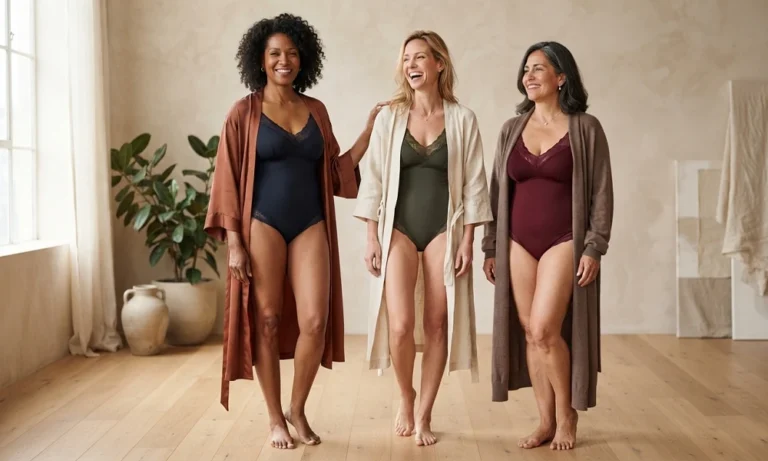
The most satisfying lingerie purchase is often the one that feels personal. It might be a delicate pattern, a favourite colour or a shape that sits comfortably beneath everyday clothes. Body-positive dressing leaves room for all of these preferences. There is no particular figure to achieve before enjoying beautiful bodywear, and no obligation to choose something revealing. The starting point is simple: what would feel good to wear today?
Begin with choice, not a body checklist.
Lingerie shopping can become tiring when every description promises to hide, correct or minimise something. A more welcoming approach starts with taste. Someone might enjoy a high neckline, another an open back, and someone else the simplicity of a coordinated set. None of those choices needs a justification based on body shape.
Dutch lingerie retailer LekkerStout offers bodysuits, bodystockings, lingerie sets, lingerie dresses and plus-size styles. For shoppers exploring exclusive lingerie, the collection offers different ways to match lingerie with personal taste, preferred coverage and different occasions.
There is also no need to feel enthusiastic about every reflection. Getting dressed can mean choosing something comfortable and carrying on with the day. Enjoyment is welcome; constant admiration is not a requirement.
Make comfort part of the appeal.
A beautiful photograph cannot reveal everything about how a garment will feel. When comparing bodywear, look beyond the overall silhouette. Check the stated materials, fastening positions, coverage and available adjustments. Consider whether a decorative detail will sit beneath a waistband or against a place where pressure is unwelcome.
The University of Arkansas shares steps towards a positive body image, including choosing comfortable clothing and appreciating qualities unrelated to appearance. Applied to lingerie, this encourages a practical priority: a piece should work for the person wearing it.
Once trying an item is permitted under the retailer’s policy, assess it in ordinary positions. Sit down, raise the arms and take a few steps. Notice pulling, slipping or a need for repeated adjustment. Those observations are useful information about the garment, rather than a judgment about the body.
Give “premium” a practical meaning.
Premium bodywear should be evaluated through specific details rather than a label alone. Look for clear product information, suitable materials and finishing that feels comfortable. A higher price or an elaborate design does not, by itself, establish that a piece will be the right purchase.
Think about how it will be worn. An occasional eye-catching piece might prioritise visual detail, while something intended beneath daily outfits may need unobtrusive edges and convenient fastenings. Neither purpose is more valid. A thoughtful purchase matches the intended experience.
Care requirements belong in that decision too. Read the individual care instructions before buying. Choosing a garment whose upkeep fits an existing routine makes it easier to enjoy wearing it again.
Treat sizing as product information.
Size labels are a shopping tool. Check current measurements against the information supplied for the particular item, especially when moving between separate sets and one-piece styles. With a bodysuit, consider torso length as well as the measurements listed in its guide.
LekkerStout states that it checks stretch and dimensions and translates many general labels into clearer size ranges. That guidance can help narrow the choice, but a broad range should still be read alongside the individual description. Ask for clarification when the available information leaves an important fit question unanswered.
It is sensible to review return conditions before ordering, too. Knowing the options in advance takes some pressure out of the decision.
Build a look around personal taste.
Start with one detail that feels inviting: floral lace, a geometric pattern or a colour already loved elsewhere in the wardrobe. Those who prefer more coverage can look for opaque panels or add a favourite robe. For an outfit beyond the home, an appropriately covered bodysuit can be paired with tailored trousers and a jacket.
Keep inspiration useful. The Mental Health Foundation’s body image guidance suggests reviewing social accounts and muting those that encourage unfavourable comparisons. Product images can help explain a design; they do not set a standard the shopper must match.
Choose something for the life being lived now.
Lingerie can offer a pleasurable moment of self-expression, but no purchase has to transform confidence to be worthwhile. Comfort, curiosity and enjoyment are enough. A favourite piece can remain entirely private, become part of an outfit or wait for the occasion its owner chooses.
Explore LekkerStout’s women’s collection, check the individual sizing details and choose a style that feels right for the body and preferences of today.