

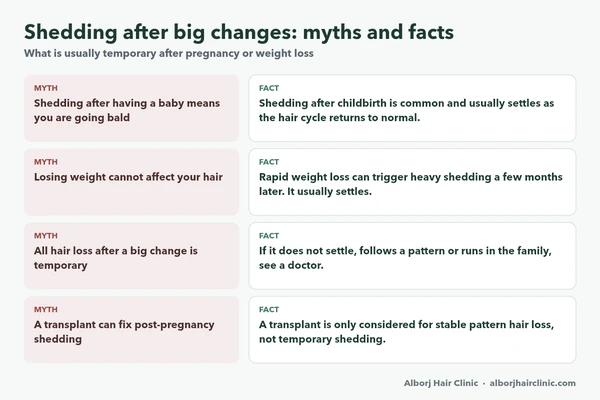
Heavy shedding a few months after childbirth or rapid weight loss is common, and in most cases it settles on its own. It happens because a big change in the body pushes many hairs into their resting phase at the same time. Hair loss that does not settle, follows a clear pattern or runs in your family is different, and is worth checking with a doctor.
Here is how to tell the two apart, how to care for your hair meanwhile and when a transplant becomes part of the conversation.
Why does hair fall out after having a baby or losing weight?
Hair grows in cycles. At any one time, most hairs are growing, while a smaller share are resting before they fall out and are replaced.
During pregnancy, many women notice fuller hair, because fewer hairs move into the resting phase. After the birth, hormone levels change and many of those hairs move into the resting phase together. Some weeks later, they shed.
Rapid weight loss can work in a similar way. A sudden drop in calories or nutrients, a crash diet or major surgery can act as a shock to the body. Doctors often call the shedding that follows telogen effluvium.
How long does this kind of shedding usually last?
The shedding usually starts a few months after the trigger rather than straight away. That delay is why many people do not connect the two.
After childbirth, shedding often becomes noticeable in the first few months. Many women find their hair is back to its normal fullness within about a year. After weight loss, it usually eases within several months once eating is steady again.
The hair that falls is often full length, with a tiny pale bulb at the root. That bulb is typical of a resting hair, and it is common in this kind of shedding.
It helps to keep a few simple notes: when the shedding started, what happened a few months before and whether it is easing. If you do see a doctor, that timeline makes their job much easier.
What signs suggest it is not just temporary shedding?
Temporary shedding tends to thin the hair evenly across the whole scalp. These signs point to something that needs a closer look:
- It does not settle. Shedding carries on well beyond the usual recovery time, or keeps coming back.
- A pattern appears. A widening parting, receding temples or a thinning crown, rather than even loss all over.
- There is a family history. Close relatives with similar thinning can point to pattern hair loss.
- Patches or other symptoms. Bald patches, a red or itchy scalp, or feeling unusually tired or unwell.
Pregnancy and weight loss can also reveal pattern hair loss that was already starting. The shedding stops, but one area stays thinner than before.
In any of these cases, see a doctor. They can look for causes and may suggest blood tests, for example to check iron or thyroid levels.
How can you look after your hair while it recovers?
Be gentle and patient. Your routine is not causing the shedding, but rough handling can add breakage on top of it.
- Loosen up. Swap tight ponytails and high buns for soft clips, low braids or loose waves to ease tension on the roots.
- Rethink the cut. Long layers or a slightly shorter style can make hair look fuller while it grows back.
- Move your parting. A new parting lifts the roots and can disguise a thinner area.
- Turn down the heat. Lower settings on straighteners and dryers help protect fragile lengths.
- Add lift at the roots. A round brush on a cool setting, a little dry shampoo or a soft headband can give fine hair more body.
- Detangle kindly. Use a wide-tooth comb from the ends upwards, and avoid brushing hard while hair is wet.
- Eat steadily. If you are losing weight, aim for gradual loss and balanced meals rather than a crash diet.
If you are breastfeeding or recovering from surgery, ask your doctor before changing your diet or adding supplements.
Who should you see first about shedding after a big change?
Start with your family doctor. They can review your health, any recent changes and blood test results, and refer you to a skin and hair specialist if needed.
A hair transplant specialist becomes useful later, once a stable pattern of thinning has been confirmed. At that point, they can assess your donor hair and stage the loss.
When is a hair transplant considered?
A transplant is not a fix for temporary shedding. It is only considered for stable pattern hair loss, once other causes have been checked and the shedding has settled.
Specialists stage pattern loss with the Norwood scale for men and the Ludwig scale for women, which has three grades. They also check the donor hair at the back and sides of the head, because that is where transplanted follicles come from. A doctor may suggest other options first.
“Shedding after a baby or a big change in weight can look alarming, yet it usually settles by itself. I only talk about a transplant once the hair has had time to recover and there is a stable pattern to treat.”
For those who are candidates, patience is part of the process. New growth usually begins at around three months, and the final look shows at around 12 months.
About Alborj Hair Clinic
Alborj Hair Clinic is a hair transplant clinic in Mazaya Centre, Al Wasl, Dubai. Its surgeon, Dr Dimitrios Ziakas, has 24 years of experience and has performed more than 4,000 hair transplant procedures. He is a member of the International Society of Hair Restoration Surgery (ISHRS) and uses the DHI (Direct Hair Implantation) technique.
Readers with ongoing, patterned thinning can find more information at alborjhairclinic.com.
The site also has before-and-after case studies from the clinic’s patients.
Frequently asked questions
Does hair lost after pregnancy grow back?
In most cases the shedding settles and hair returns to its usual fullness. If it does not, or a pattern appears, see a doctor.
Can a crash diet cause hair loss?
It can. A sudden drop in calories or nutrients can trigger shedding a few months later.
Should I consider a hair transplant after pregnancy hair loss?
Not for temporary shedding. A transplant is only considered for stable pattern hair loss, after other causes have been checked.
When should I see a doctor?
See a doctor if shedding does not settle, comes with patches or other symptoms, or you notice a pattern forming.

Comments are closed.