

Walk into any jewellery store today, and you’ll notice something interesting almost immediately. Mangalsutras no longer sit in a separate, ceremonial corner. They’re lighter, cleaner in design, and often styled alongside everyday chains and pendants. This shift didn’t happen overnight, and it didn’t happen without reason.
As lifestyles changed, so did expectations from jewellery. The mangalsutra, once designed mainly for symbolism, began to adapt for comfort, daily wear, and personal style. What we see today as modern mangalsutra designs is actually the result of years of evolution, shaped by how women dress, work, move, and choose for themselves in contemporary India.
When Mangalsutra Started Following Lifestyle
The biggest shift didn’t start with mangalsutra design; it started with daily routines. As workdays grew longer and wardrobes became more fluid, jewellery began to take on a new role. It was no longer about dressing up for moments. It was about wearing something that could stay on all day without drawing attention.
Mangalsutras, which were once designed with visual prominence in mind, slowly began adapting to this rhythm. The chains became lighter and the pendants more compact. Details were refined so they didn’t catch on clothing or feel heavy by evening. These weren’t dramatic changes, but together, they made the mangalsutra easier to live with.
Fixed Forms to Flexible Expressions
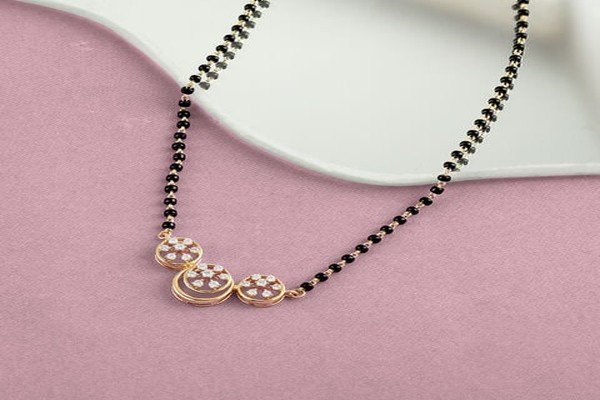
Earlier, mangalsutras followed a fairly predictable design language. Today, there’s room for variation, and more importantly, for personal choice. Some designs lean towards minimal pendants with clean lines. Others explore gentle curves, contemporary motifs, or subtle diamond accents.
What’s interesting is that none of these designs try to replace symbolism. The black beads remain central, and gold continues to anchor the piece. The difference lies in scale and interpretation. Modern designs allow the mangalsutra to reflect the wearer’s personality rather than override it. This flexibility has made the mangalsutra feel more personal – something you choose because it fits you, not because it fits a rulebook.
Comfort Became a Design Priority
Comfort wasn’t always a design consideration. It is now. Modern mangalsutra designs are created with the assumption that they’ll be worn often, not occasionally. That changes everything from weight distribution to clasp mechanisms.
Material choices play a key role here. Pieces set in 14 KT and 18 KT gold support lighter constructions while still offering durability. These options make it possible to create pieces that feel secure yet unobtrusive, sturdy yet easy to wear.
Styling Without Ceremony
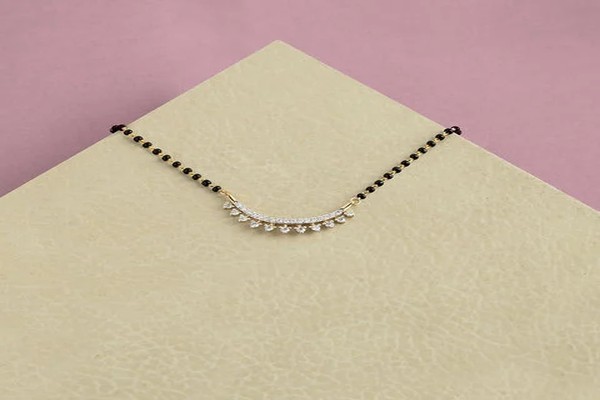
Another reason modern mangalsutra designs resonate today is how naturally they blend into contemporary wardrobes. They don’t demand a saree or a festive blouse. They work just as well with workwear, cotton kurtas, or even layered outfits.
This ease of styling removes the mental checklist that often came with traditional jewellery. You don’t have to think twice about whether it fits the setting. It simply does. That’s a powerful shift that allows tradition to exist without ceremony. Over time, this familiarity changes how the mangalsutra is perceived. It stops being something you “put on” and starts being something that’s just… there.
How Has Urban Living Influenced Mangalsutra Design Choices
Urban living has quietly reshaped expectations from jewellery, and the mangalsutra has evolved along with it. City routines are rarely predictable with days starting early, stretching long, and moving between work and personal spaces with little pause. In this context, jewellery needs to be easy, comfortable, and unobtrusive.
Modern mangalsutra designs reflect this reality through lighter chains and compact pendants that sit comfortably through long hours. Proportions feel more balanced, designed to stay on rather than demand adjustment. These designs work across changing dress codes, from professional wear to everyday outfits. What stands out most is the emphasis on effortlessness. The mangalsutra no longer sits apart from daily life but blends into it naturally. Urban living hasn’t reduced its meaning; it has simply made space for it within real, modern routines.
Regional Influences in Contemporary Mangalsutra Design
India’s diversity still shapes mangalsutra designs, even in their modern forms. Regional preferences subtly influence chain lengths, bead patterns, and pendant styles. What’s changed is how these elements are refined and simplified, allowing regional identity to exist within a more contemporary framework.
- Roots in local traditions: Across India, mangalsutra designs have historically been shaped by regional customs, whether through chain length, black bead spacing, or pendant form. These elements formed a visual language that was closely tied to local culture and practice.
- Subtle reinterpretation, not replication: In modern mangalsutra designs, these regional preferences haven’t disappeared. Instead, they’ve been refined. Longer chains may subtly reflect certain regional styles, while compact pendants echo areas where understated design was always favoured.
- Refined bead patterns: Black bead arrangements often carry forward familiar regional rhythms, but with lighter construction and improved balance. The focus is on comfort and wearability rather than visual density.
- Design guided by proportion: Rather than recreating traditional designs exactly, contemporary mangalsutras let regional influence guide proportion and structure, resulting in pieces that feel familiar without appearing dated.
- A flexible, pan-Indian design language: What stands out today is how regional identities coexist within a broader design approach. Modern mangalsutra designs don’t limit wearers to a specific regional aesthetic, making them adaptable across personal styles and locations.
- Cultural connection without rigidity: This evolution allows women to carry a quiet sense of familiarity, and sometimes nostalgia, while still wearing jewellery that fits naturally into contemporary wardrobes and everyday life.
What This Evolution Really Tells Us
At its core, the evolution of modern mangalsutra designs reflects a broader cultural truth. Tradition doesn’t lose value when it adapts. It gains relevance. By responding to how women live today, how they dress, work, move, and express themselves; the mangalsutra has found a new rhythm.
It no longer sits apart from daily life. It moves within it. And in doing so, it continues to hold meaning, just expressed in a quieter, more personal way. In today’s India, the mangalsutra hasn’t changed who it’s for. It has simply changed how it shows up.

Comments are closed.